
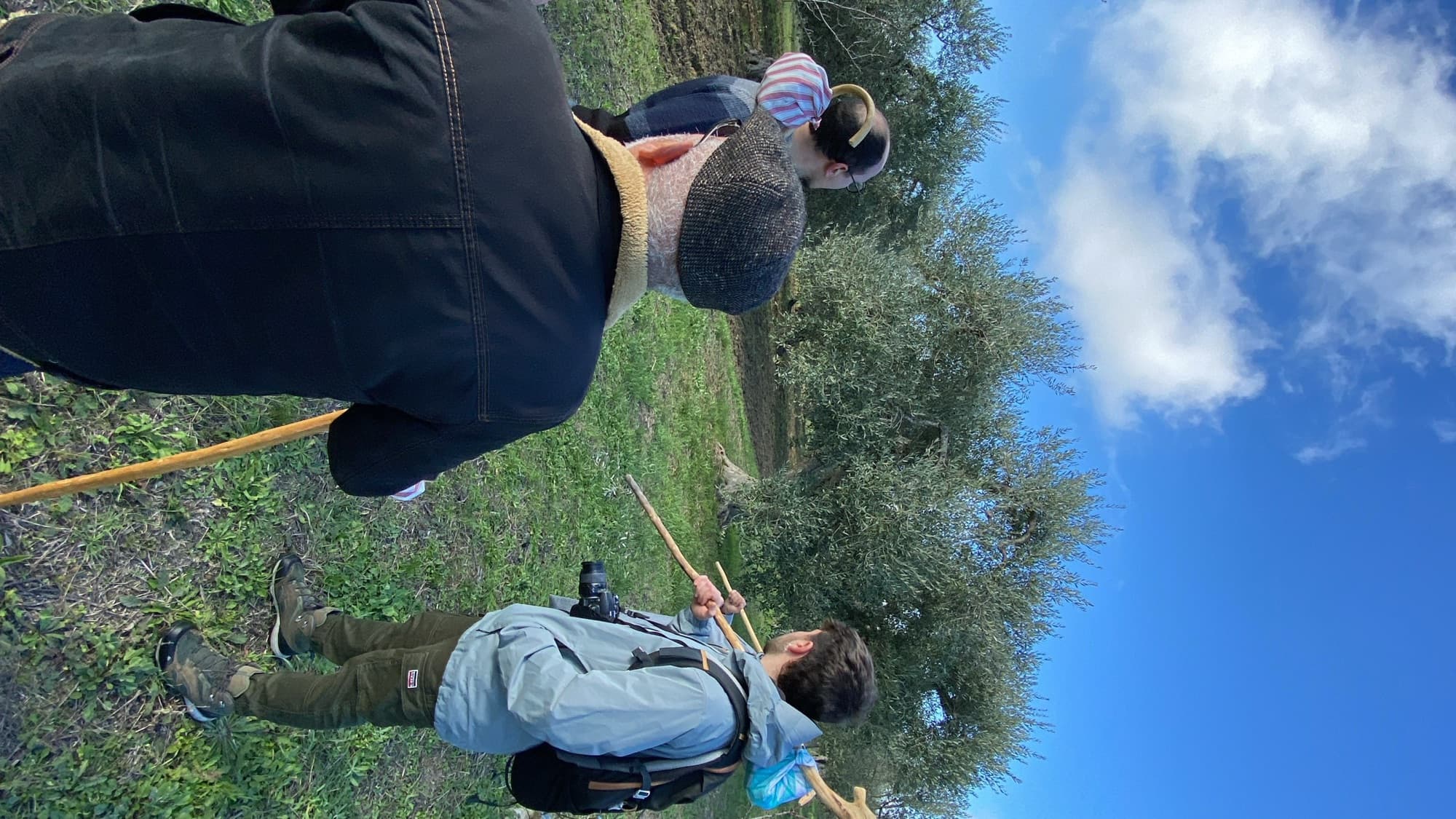
A guide tells the story
The Patriarch Olive Trees
The story told by the person who guides visitors every day through the centuries-old olive groves of San Giacomo and Masseria Mandola Lena.
The Oliveti Ritrovati project
The “Oliveti Ritrovati” project was born to make the rich Italian olive heritage, especially that of Matera, known to Italian and foreign visitors, offering them an immersive experience in the olive groves.
From “Oliveti Ritrovati” comes “Percorsi Ritrovati”, the tourism initiative that brings to the fore the agricultural traditions our families have preserved and handed down for generations: the true history of this land.
The San Giacomo grove and the Patriarch
The olive grove of San Giacomo, near Matera, has 92 trees, 25 of which I inherited from my grandfather. We took over the others, abandoned, founding the Slow Food community “Oliveti Ritrovati”. Trees with at least 200 years of history.
We stand in the shade of the “Patriarch”, a majestic olive tree left close to its natural shape. A nearby tree, pruned with the “polyconic pot” technique a year and a half ago, shows more vital leaves: pruning lets light in, favouring photosynthesis and keeping pests and disease away.
The olive tree also plays an ecological role: its slow growth makes it a store of organic matter and carbon, holding onto what would otherwise be released into the atmosphere.
The soil, the orchids, the tasting
We don't till the soil: wild grasses grow freely, then are shredded together with pruning residue, forming an organic blanket that enriches the earth without any need for external fertilizer.
On this strip of land, five different species of wild orchids have appeared: a sign of biodiversity, including the microbial life at work in the soil that stays invisible to the eye.
Under the olive tree we set up a small table to taste our oil on a slice of Matera bread, with fresh oregano leaves. Oil from real olives is bitter: be wary of sweet oils.
Masseria Mandola Lena
A few kilometres from Matera, in the Mandola Lena district, an area historically given over to olive groves. Here stands the chapel of Sant'Isidoro, a Spanish saint who protects farmers, depicted in peasant clothes next to oxen.
Above the door is the date 1802 and the Latin inscription “HEC EST DOMUS OMNI” (“this is everyone's home”); above the window, in old Italian, “QUI NON SI GODE ASILE” (“here there is no refuge”). Two opposite messages that together tell of the religious community's hospitality and the fear, rooted in the countryside of the time, of livestock theft.
The fortified farmhouse, its buildings arranged in a circle around a single great gate, bears the date 1822 on the entrance arch: twenty years after the chapel, a sign that the religious community came before the productive activity.
The Gravina ravine and the rock-cut crypt
Facing it, the Gravina: a canyon carved over millions of years by rainwater into calcarenite, a rock of marine origin where fossils and shells can still be found.
On the opposite slope, openings carved into the rock: shelters of Christian religious communities that arrived from Eastern Europe five or six centuries ago, living by agriculture and foraging.
We enter a hand-dug crypt: the doorway bears a graffito of a cross on Golgotha; a plastered niche marks the chapel; the smoke-blackened ceiling reveals the shared hearth; the stable next door helped heat the space.
On one wall, the date 1637 and the letters IHS (“Iesus Homini Salvator”). In the frame, a puzzling Latin inscription: “INCIPIENS ALIQUID FINIS? CO(N)SIDERET… ATE” — whoever begins something should not overlook its end. An invitation, four centuries ago, to live in harmony with others and with nature, because life is short.
The Cialledda
Matera's quintessential dish, born from the absolute poverty of the Sassi districts until the 1950s: stale bread, never thrown away, soaked and reused with tomato, cucumber, oregano and oil.
Legend has it the name comes from “cialliddare”, to chat: the gesture of Matera's housewives preparing this dish together in the alleys of the Sassi for their families.